Sunday, June 30, 2013

Regarding The Vicelords


Most residents of the frontier are aware that, amongst the ranks of godlings and devils, there exist a category of nebulous creatures called the Lords of Vice, who feed on human pleasure.  These Vicelords are numerous, and vary in power, but share certain common traits, according to scholars, priests, and wizards who study such things.  Vicelords, whatever their size, feed on some aspect of human emotion, typically pleasure, elation, sense of belonging, or regret - or some combination of these.  The manipulation of emotion at a distance is a common ability of Vicelords and their minions.  Often a vice-spirit will have the power to instill a certain emotion in its prey, confident that it will soon turn to a different emotion on which the spirit can feed (for example, providing a temporary 'high' which soon turns to sadness or depression).  The Vicelords are immortal, possibly eternal, and, with few exceptions, do not themselves travel on the material plane (although their minions, servitors, and cultists certainly do).

Although often confused with devils, it must be remembered that the Lords of Vice are not, properly speaking, diabolic, although they care little for human life and are happy to manipulate mortals.  Vicelords and their minions are, in some ways, spirit-creatures of emotion, as natural as fairykind.  Some mortals have taken to worshipping the Lords of Vice, directly or otherwise, and this has increased their power.  Clerics and wizards who pay homage to the Vicelords inevitably are granted some measure of vice-related power.  Generally, however, a given follower of the Vicelords will pay homage to multiple, known, Lords; they are considered a group or assemblage, a sort of parliament of godlings who each have their own goals, yet together represent something greater.

Most Lords and Ladies of Vice are affiliated with a single activity which mortals might consider a vice: consumption of alcohol, tobacco, or other drugs; gambling and self-risk; or sexual hedonism.  It is these connections which differentiates a Vicelord from some lesser fairy correlated with chocolate, for example, but it is perhaps a continuum.  Are the Vicelords merely a category of fairy-kin?  Are they elemental spirits of overindulgence?  No one can say for sure, although their minions are not easily banished by priests.  Some scholars suggest that the Vicelords exist in Wampus Country because of the power of bazoul, that constant psychic field which connects all sentients and boosts fellowship around the campfire.  In a world such as ours, where we are all a part of this enchanted network, rogue intelligences might achieve sapience within that web of emotions, and grow in strength until claiming a seat within the parliament of Vice.

The Crimson Buccaneer, a Vicelord considered a patron of thieves.

The Wanderer is said to have multiple aspects which it projects into the mortal realm.

This gigantic fruit-bat is a traditional rival of the Crimson Buccaneer.  Its cult has made subtle inroads inside the Church of the White Mouse of late.

The Prince of Smoke has many traits of a bestial deity of disease.

Wampus Country is greatly in the sway of the Vicelord called "Ol' Red".

The Cyclops is an appealing patron to starving artists.


Thursday, June 27, 2013

Zombies and Getting Time-Lost: An Update on Lord Vallasen's Castle

Strange things are afoot at Lord Vallasen's Castle.

My son, who recently turned eight, has been assisting me in chronicling the adventures of Lord Vallasen off and on for a while now.  Sometimes it's more like playing D&D, other times we're just riffing make-believe with him as the same character.  Regardless, it's canon. And that can get weird, especially during the adventures where I give him a longer leash on narrating the action.

Vallasen's adventures lately had been side-missions here and there while his recently-acquired castle was repaired, and mercenaries arrived to serve as his (small) garrison - they're hirelings, not a retinue per se, as Vallasen's only a 4th level fighter.  Lord Vallasen now has a dozen scouts in his employ (buckskins, rifles, etc), and he recruited one Major Hootenanny as his seneschal and fighting right hand.  Trusty sidekick Fish-Man is still around, although relegated to a less-martial role of late as the team gadgeteer; and faithful steed Wiggy-Bench (the animated park-bench) hangs out basking in the castle courtyard when not required for a quest.  Also worth knowing is that Lord Vallasen has done some more exploration of the stranger rooms of his new castle, and has some understanding of how to work the "Time Chamber" (which may be more of a cross-dimensional teleporter thing, he's not quite sure yet) and its portable recall device.

One of the problems inherent in owning a castle is that eventually it gets attacked by an army of zombies.  In Vallasen's case, the castle was besieged by a force of shambling zomboids early one morning, and the young lord found himself and his retinue surrounded by vicious, grasping claws.  Currently he thinks it may have something to do with the green monster he found in his kitchen, drinking all his soda - there may indeed be a connection between the furry beast (which was promptly slain) and the zombie army.  There was a mighty battle as the scouts fired down from the walls, but eventually they would have to run out of ammunition, so Vallasen hatched a multi-part plan.  Supposing that zombies cannot swim, Vallasen and Major Hootenanny heroically snuck out a sally port and lured a component of the zomboid force down to the river, where they were battered by the rapids (and Vallasen almost drowned before being rescued by Hootenanny; pay your retainers, people).  (Note to self - add "hapless zombie thrashing around in the water" to river encounter table)  They then returned to the castle to try to finish breaking the siege.  A few of the scouts had moved the one cannon up to a tower, and it was doing a good job of blowing away zombies here and there.  An entire crate of small spiders was dumped on the zombies in the meantime (spider venom sometimes causes zomboid flesh to melt, so this was partially effective).

Lord Vallasen then realized he might be able to use the gallon of magic peach nectar he'd acquired earlier to solve the zombie problem.  He didn't know what the nectar would do when it contacted zombies, but anything was better than the current situation, as both Vallasen and Hootenanny had been bitten, and would soon turn into zombies themselves unless all the zombies were destroyed.  As it turned out, the magic peach nectar, when dumped over the wall, turned some of the zombies into velociraptors.  Less than helpful.  However, Vallasen thought he might be able to convince the velociraptors to come over to his side, so he ordered Hootenanny and the scouts to bring up all of the meat furniture from his Meat Lounge and toss it over the wall.  Yes, the Meat Lounge - where the young lord kept his collection of things made out of meat.  Gone was the bacon end-table, gone were the beef chairs, gone was the porkchop bookcase.  But the plan worked - sated by the offering of meat, the velociraptors switched sides and started holding off the zombies.

More magic peach nectar was needed!  Scouts were dispatched to the peach grove outside the castle walls, but they came back with only a single rotten peach, as the trees were no longer producing.  Solving a problem as only an eight-year-old can, Vallasen ran for the Time Chamber, in hopes of going backward (or forward) to a time when there were peaches on the trees.  As usual, the Time Chamber didn't do what he wanted it to do, and Vallasen, Hootenanny, and a small group of scouts were thrown back into something resembling the late Triassic.  After dodging some immense dragonflies, Hootenanny spotted an immense peach-like fruit hanging from a tree in the are where the magic peach grove maybe-should've-been.  But before the huge thing can be pulled down, Vallasen is carried off by a pterodactyl!  The leathery-winged beast is driven off by a fusillade from the scouts, and Major Hootenanny catches his liege before he splats (that's two - seriously, be nice to your hirelings).  The giganto-peach is cut down and cut in half so it can fit in the 'summon radius' of the Time Chamber's recall device.

Mid-transport, Major Hootenanny cries out in alarm and pain - there is some prehistoric serpent biting his foot!  The darn thing must've snuck into the radius of the Time Chamber -- and apparently its bizarre poison mutates Hootenanny to have a snake-face.  Unfortunately all of the ruckus seems to disturb the time-transport, and the group ends up in a place that seems like the Edwardian period ("It's definitely 1919," said Lord Vallasen).  They quickly learn they are in a pocket dimension called the Magic Land of Neckties, which is ruled by a council of Necktie Wizards; and, strangely, there are some zombies here, too, acting as servants to the magocracy.  Weird connections!

Vallasen and Hootenanny acquire neckties so they can sneak past some zombie guards and...why did we do that again?  I seriously don't even remember, and it was earlier today.  Anyway, there's a chase scene as they abscond from the zombies and Necktie Wizards and leap back into the Time Chamber's field just as some jerk wizards throw energy blasts at them...   And of course there's no way that won't mess up the time-jump, right?

"Where are we, m'lord?" asked Hootenanny, staring up at the swirling violet colors in the sky.
"I'm not sure.  The readout is weird." Vallasen offered grimly.
"How weird?"  The grizzled soldier narrowed his eyes, anticipating an upsetting answer.
"The time-o-scope says we should be in the year 8080, but all the science readings say we are in The Time Before Planets Were Born."
"That's an actual time?"
"Oh, yes.  And we're really there.  For realsies."

TO BE CONTINUED

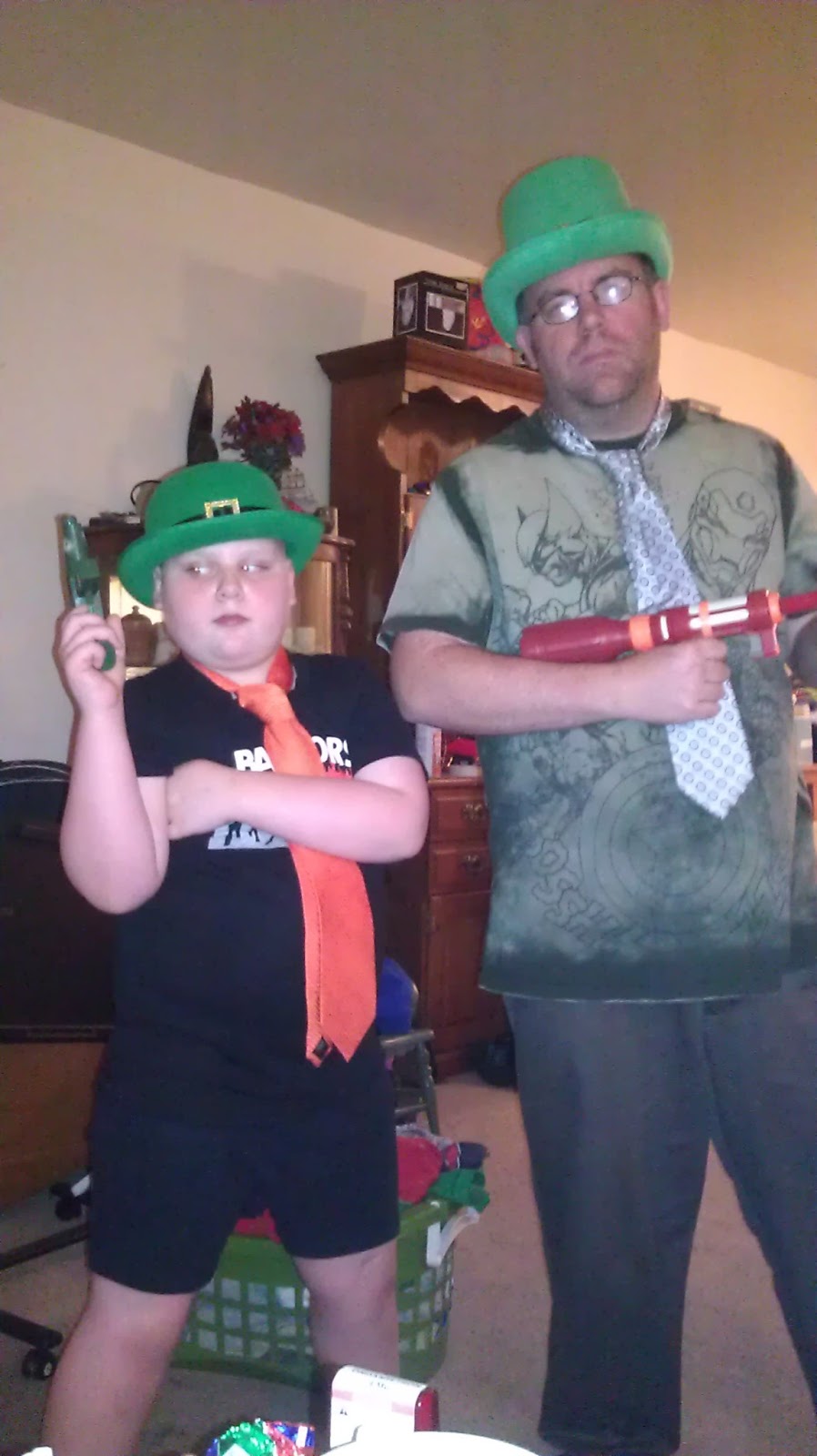
Lord Vallasen (L) and Major Hootenanny (R), in disguise while operating in Magic Necktie Land.  Note the Wampus-hats, and that Hootenanny now has the face of a cobra thanks to mutation.


Reviews: Hall of Bones, MCMLXXV

In the past month, I've gone from owning zero Frog God products to having two of their introductory adventures - I received MCMLXXV (hereafter 1975) in a swag bag at NTRPGCon, and - perhaps like you - I grabbed a copy of Hall of Bones on Free RPG Day.  Since I'm on a bit of a review kick, I thought I should talk about these two products in tandem, because they have a lot in common; I regret that I don't have a copy of Grimmsgate, Frog God's third intro module.  Possible content spoilers for both adventures follow.

An introductory adventure is a low-level adventure, but it has extra requirements.  After all, the expectation is that this product could be the first adventure somebody runs or plays in, and for all we know it might be their first roleplaying experience to boot.  Things need to be fairly basic - but "basic" is not equivalent to "vanilla", and I think that's where both these adventures fall a bit short.

1975: contains precisely zero badass energy dudes.


1975 and Hall of Bones, both by Bill Webb, start identically with an "Old School Primer" about playstyle, xp, henchmen, and so forth, which serves as a good intro for people only familiar with more 'modern' forms of D&D.  Hall of Bones has a short rules overview for Swords & Wizardry at the very beginning, which is nice and potentially turns the module into a quickstart, as there are pregenerated characters at the very back.  In both cases, there's some wasted space at the end of the introductions which could've been filled with evocative art from the Frog God vaults, or with more information or something.  The inclusion of quickstart rules and pregens puts Hall of Bones in the lead here, as far as intro matter goes.

Let's get to the meat of the two adventures.  In 1975, the adventurers are presumed to be following a treasure map down into a valley.  Random encounters are provided for traversing the valley; some of them are standard, like bandits, wolves, or a caravan, but others are more interesting - a falling meteorite (along with notes on harvesting the strange ore within), a crazy person, and an ankheg.  (Did ankhegs always have a whoopass 5d6 breath weapon?  Seems harsh for an introductory adventure, but hey...)  Further sets of random encounters for the forest and the swamp include spiders, kobolds, an owlbear, some grey ooze, the always-awesome giant beaver, etc.  Oh, and did I mention the black dragon?  Yeah, it can spit acid for 18 points of damage, so...  Maybe they're trying to tell us that life in S&W is sometimes lethal and you get your face melted off by a subadult dragon that hides under the water.  Some keyed encounters follow, including more bandits, an ogre and his pet bear, rats, spiders, snakes, goblins, shriekers, crocodilesand - inexplicably awesome relative to the rest of these creatures - a leprechaun.  Finally, the treasure map leads to a small cave complex which contains several nasty traps, a cockatrice, and, potentially a vrock.  I'll say that again: a vrock.  If it's any consolation, the treasure at the end is considerable for first-level PCs.

Hall of Bones: does indeed contain skeletons.

Meanwhile, over in the Hall of Bones, we have a shorter adventure (due to the wise inclusion of the quickstart material) focused tightly on the eponymous small dungeon - no wilderness here.  Within the dungeon, the PCs will be grappling with spiders, ghouls, some pretty cool purple moss, rats, and a shrieker.  The boss of the dungeon is a variant undead called a bone cobbler which commands some skeletons; the cobbler guards a very interesting piece of magic treasure, and this room is therefore the best bit of the micro-dungeon.  I'm not sure why Hall of Bones includes a full-page map of the ruined village above the dungeon without saying anything interesting about the village itself.  The pregens at the back are nicely illustrated, but with a lot of negative space.  I understand that you're intended to photocopy them and hand out the PCs to your players, but these could've been half-page character sheets.

Basically the pattern is "vanilla but functional low-level encounters, spiced up with wet-your-pants stuff".  I mentioned the vrock, right?  1975 has some nice random encounters.  Both modules fall on the bland side.  Now, I'm not saying these should've been gonzo or really "out there" or anything.  But you can present an interesting, evocative low-level adventure without doing the "goblins, spiders, and rats" thing.  Nary an NPC to be seen except the two (different) "madmen" in 1975.  If an adventure is to be introductory, I think it better serves the customer - and the hobby - if it really grabs people with exciting concepts.  Imagine two groups of new players, each playing through one of these modules, conversing a couple of years later about their first forays into Swords & Wizardry...  "Yeah, we played that intro adventure with the spiders and rats."  I understand that there's something to be said for replicating "our" early D&D experiences (many of which featured spiders and rats), but...I think I would have been more excited about an introductory adventure that got players excited (directly) about Rappan Athuk or the Slumbering Tsar or something, or which was a direct drop-in to the Hexcrawl Chronicles or Stoneheart Valley.  Come on, Frog God, pimp your stuff in a way that upsells me.

Of the two, I would easily say 1975 is the better acquisition - it's longer and contains some wilderness encounters.  1975 is currently available from Frog God;  Hall of Bones will be available on 1 July (as is standard for Free RPG Day products), but it'll be $4.99 in pdf.  That's a mistake; Frog God would do well to put Hall of Bones up as a downloadable freebie quickstart; I think it would serve in that role better than as a for-money product.  I like the folks at Frog God, especially after having met (and played with, and smoked cigarettes with) several of them at NTRPGCon, and I'd love to see them do really well; intro adventures can be a delicate thing.


Wednesday, June 26, 2013

Review: Kefitzah Haderech


Magical portals are a mainstay of fantasy, from the bizarre and ancient standing-stones of fairy-kind to the ubiquitous magic doors of Elminster-type wizards.  Lost Pages - the imprint of Paolo Greco - has published a 32-page treatise on magical portals of all sorts entitled Kefitzah Haderech: The Incanabulum of the Uncanny Gates And Portals.  Kefitzah Haderech is available at the Lost Pages store (print and pdf) and also at d20pfsrd (pdf only); Paolo was kind enough to provide me a pdf copy for review purposes.


"Kefitzah Haderech" refers to the "shortening of the ways" - the ability of miraculous figures (to include certain rabbis) to step instantly to a distant place.  If this supplement had been entitled "The Book of Portals", you might be right to expect some boredom within.  Luckily, the flavor of the title carries through to the content.  Although the book begins and ends with commentary (types of portals, using them in your game, inspirations), the meat of the work is a series of nice random tables to assist and inspire in the generation of portals, keys to those portals, and their destinations.  There is also a short section on constructing magical portals - a bit on cost, but primarily a table full of methods of portal construction (which may or may not work in your campaign world).  Each of these is flavorful and serves as an adventure seed for those PCs seeking to build their own portals, or to assist the GM in understanding the machinations of a powerful sorceror looking to establish a portal network.  Just reading over the list gives me ideas - especially for botched attempts at creating a portal.  Next in the toolkit is the "Portatron", a system of randomly generating a magical portal by means of rolling a handful of disparate dice (a d10, a d20, etc) and then reading the results as mapped to the various tables.  This set will be useful for adventure-writing as well as on-the-fly portal creation (hey, sometimes that comes up).

Then we get to the Big Daddy of Portal Tables: a d666 table (roll three six-siders) of portal destinations.  This thing is worth the (very low) price of the supplement by itself, as it generates all manner of actually interesting destinations, each one featuring hooks for immediate use by the improv-happy GM.  Any one of these could easily jumpstart a flavorful series of sessions in the new location - it's everything from elemental destinations to other worlds and time-jumps.  Keep in mind you don't need a portal to need a weird destination - there are always botched teleportations, planar travel mishaps, etc.  I would love to end a session with a jump, where even I don't know where the portal leads, and make the players roll the d666 (so it's their fault) and then describe what they see in the new place as a cliffhanger.  Presumably I'd have a week to work off of that image for the next session...  But I think if you were of a mind to do a "malfunctioning TARDIS" type campaign, you could just use this table and have several years' worth of awesome sessions.

Kefitzah Haderech contains very little in the way of system-dependent mechanics (other than references to 'turns' and vague estimates of power levels of denizens) and could easily be used with any game that has a call for magic portals or out-of-control crossdimensional antics (to include Call of Cthulhu, Doctor Who, and even Star Trek pastiche games).  Given the price point ($2.50 in just pdf, $4.99 for print + pdf), this is a supplement well worth picking up for the avid GM - you'll find use for its inspiring tables across several different games, and may find yourself wanting to run a portal-hopping campaign once you've flipped through it.


Tuesday, June 25, 2013

Excerpts from Pazoodle's Modern Lexicon

When you make up silly words, ask your eight-year-old to define them, and then extrapolate to try to make that fit in your D&D setting, you get something like this.  Kudos to the Boy, Mrs. Wampus for playing along, and the Plus Squad who suggested more words when we ran out.


EXCERPTS from PAZOODLE's MODERN LEXICON
a very fashionable frontier dictionary

slangamok - noun or verb.  Onomatapoeic representation of the sound of a sword or axe colliding with the head of a giant; or, verb form of same.  Used today by some youths as a synonym for 'superlative', or to describe a really good drinking party.

flazzlenazzer - noun.  1.  a miniature lavender goat, insectivorous, which dwells in underbrush; its spoor resembles fallen blueberries to an unfortunate degree.  2. disparaging term for someone who smokes cigars while holding an infant, or who seems the sort of person to do so.  

flooge - noun.  A peculiar subspecies of grizzly bear, chestnut in color,  whose head is continuously on fire; the flooge rips chunks of meat from its prey, then sears them on its forehead before consuming.  When hibernating, the flooge merely smolders.

boongammer - noun.  1. a tremendously fat nocturnal bird whose deep call has a tendency to lock or unlock nearby doors.  2. any portly burglar.

clogdoggle - noun.  1. a wolf-trap designed to introduce, by means of a spring, a glue-coated cork into the fundament of the animal.  2. a really stupid idea on which too much time has been wasted.

frexallate - verb.  To cause confusion in another by means of loquaciousness.

plaggette - noun.  Consumable toothpick made of hard bread, typically flavored with bacon-grease and hot sauce.

wangatoor - noun.  A portable calculating device in the shape of an antelope.

hambedaggler - noun.  One who makes his living by sculpting wedding centerpieces out of pork.

walepoke - noun.  A roadside restaurant that serves small hamburgers to passers-by.

sardonizer - noun.  A stone mug reserved solely for drinking warm milk.

munciflage - noun.  1.  A crank-powered miniature orrery and bellows, bearing suspicious probe-hoses, used by sorcerors to understand the nature of a demonic possession; diagnosis is made based on certain pressure differentials.  2. An uncomfortable but necessary task is said to be munciflaginous.

abbloviment - noun.  1.  A secret room or crawlspace in a house, typically on the second story, designed for hiding malformed or insane family members.  2.  The hollow space inside a poison-ring.

klangodontia - noun.  A shop or stall which sells lobsters and other sea animals.

gurphotrophy - noun.  A fondness for unusually-propelled vehicles.

fruzoont - noun.  A poisonous black-and-white flower which grows only in crone-gardens.

hooblemous - noun.  A burglary-tool for the scaling of chimneys or tall trees, consisting of a harness and crotch-spring.

blort - noun.  A white and yellow honeybee bearing a human-like face.

frumkin - noun.  An egg-shaped confection composed of cashews and persipan, traditionally gifted to unpopular neighborhood widows on holidays.

woggle - verb.  1. To force-feed alcohol, typically bourbon, to a cow or goat, in hopes of producing intoxicating milk.  2.  To attempt something which seems like it ought to work, yet probably won't.

snogg - noun.  A man-eating beast which resembles an immense green rat and has a habit of hiding in kitchen cabinets.

blinkle-belly - noun.  A blend of root beer and honey-mead, served over ice with a splash of cherry juice.

fistlesnitz - noun.  A small silver spike or hook mounted on the pommel of a sword, allowing a horseman to clean his nails as he rides.

gobclomp - noun.  A spring-loaded clamp designed to hold wet handkerchiefs, typically mounted in a cloakroom above the umbrella stand.

jerryfussle - noun.  A trenchcoat stitched together from childhood blankets, said to ward off evil spirits when worn.

magnarazzo - noun.  A small construction of cured leather stuffed with goose-down, often decorated with beads and worn across the upper lip; to wit, a codpiece for your moustache.

squism - noun.  The wet mark which remains after hurling a kitten against a brick wall.

crappelgork - noun.  A makeshift polearm made from a post-hole digger.

luski - noun.  A small flowering berry-bush which drops its leaves when shouted at in anger.

parrow - noun.  The bastard offspring of a parrot and a sparrow, which amuses itself by giving travellers poor directions.

mulpetty-moo - noun.  The anguished sound emitted by portraiture which knows it is badly painted, audible only to maladjusted children and blind cats.


Monday, June 24, 2013

Uses for Mooses

Some moose today.

Hat-tip to Jack of TotGaD for sending this pic my way.  This first bit is yanked from a G+ convo the other day.  Ladies and gentlefish, the Moosocampus.

Tis a lucky adventurer indeed who manages to tame a moosocampus, whose strong back and finned limbs can carry a seeker-of-gold quickly across the water, or even underneath it; for he who licks the magic antlers of the moosocampus can breathe water for a turn. Constant antler-licking may be required for deepwater exploration. 

 The nongendered moosocampus reproduces by capturing genetic material from the fish it eats and combining it with his own, laying eggs quite sensibly once a year in a submerged nest which it defends vigorously, sometimes going so far as to hire mercenaries to patrol the area during the crucial last week of incubation. Although they are quite intelligent and speak fluently, moosocampi are burderend by a congential curse; each moosocampus must deliver its speech in the cadence of a popular song, which becomes its name amongst both moosocampi and men. 

 The pictured specimen, Won't You Come Home, Bill Bailey, spent some time as the willing steed of the adventurer Arthur 'Scissor-Face' O'Gowan, also pictured; their association came to an end when O'Gowan was callously shredded to pieces by razor-eels after a night of careless drinking. Such is the tale the moosocampus told local authorities, and one presumes he meant that O'Gowan was the one doing the reckless drinking, but one should never discount the possibility that it was the razor-eels who had been raucously tippling. In any case, the outcome was the same.

Shavings from moosocampus antler can be used as a major component in crafting potions of water breathing, as one might expect.

The takeaway lesson is that I write silly stuff very quickly at 9am, especially if it's got a moose in it.  Which of course brought up Teddy Roosevelt, which led to the resurrection of this old thing, from a "Stat Teddy Roosevelt for your game" thread on the RPGSite...

Lord Teodor of Rosefield
"The Bull Moose of the West"
9th-level Fighter (Lawful)

STR 13
DEX 14
CON 15
INT 16
WIS 11
CHA 15

Special ability: Legendary moustache. Over a decade ago, Teodor was rewarded by a fae countess with a strange blessing - so long as his moustache is of a certain length, Teodor receives +2 to all his saving throws.

Standard gear: Lord Teodor has at his disposal some very fine arms and armor, but unless clad for battle, he tends to wear garish, patchwork hide-and-leather armor constructed from the pelts of beasts he has killed himself. Complimenting this ensemble is a cloak of displacement enchanted from the skin of a displacer beast Teodor killed - reportedly - with his bare hands. He is skilled with bows and crossbows, and usually bears a battleaxe. Teodor also often wears a pair of enchanted spectacles which heighten his senses and increase his ability to detect secret doors or track animals.

After spending the bulk of his life as an adventurer and explorer, Teodor became embroiled in local politics at the ducal level for several years. Now, following the assassination of Wilhelm of Kinlay, Teodor has taken over lordship of the area, equivalent to a Marquess. Although he offers fealty to the King and is generally loyal, Lord Teodor has quite an independent streak, and has acted against the merchant guilds on more than one occasion. He is sympathetic to young adventuring-types, and might make a suitable patron, especially for a brash warrior or outdoorsy type.

Obviously this Teddy was written up during the "proto-Wampus" phase of the campaign several years back, when there was a lot more medieval stuff going on.  Now here's something a little different...

FURY OF THE VINCAL
In the time of Grandpa's War, the general desire to experiment magically was quite low, especially as regards sorcerous transformation of people.  The previous generations' failures with gigantism were fresh in memory, and no state or association of consequence would fund such experimentation.  Independent wizards, however, continued their research unhindered, certainly if they had access to ill-gotten gold or strong revenue streams obtained via investment.  One such sorceror was Vincal, who had certain theories regarding lycanthropy and sought to put them to the test.

Vincal's chief idea, to truncate a lengthy magical paper he published, was that the issue with lycanthropy lay in the nature of the beasts wedded to the curse.  Wolves, bears, tigers - all predatory species which, according to Vincal's manuscripts, were ill-suited to human adaptation (note that wereboars were relatively unknown at this time, and werebats unheard of).  The wizard sought to create a strain of lycanthropy using a powerful herbivore - in this case, the moose - which could be injected into volunteers.  

This feat was managed on a small scale, and Vincal successfully transformed about a dozen men and women into moose-kin, both bull and cow.  The serum did exactly what the wizard wanted it to do - transform normal humans into towering half-moose warriors.  These semi-lycanthropes, which bred true, did not fully shapechange into moose, but instead took onto themselves characteristics of the beast - size, strength, powerful antlers.

Unfortunately, certain then-potent authorities caught wind of Vincal's experiments, and ran him and his moosekin out of town.  Pamphlets were circulated condemning the "Vincal Heresy", and soon all the mooselings bore the wizard's name.  As Grandpa's War came to a head, the predictable occurred - the Vincal came out of hiding in the piney woods and struck at the forces of Law in a series of brutal raids.  There could be no turning back - the Vincal were now not just politically condemned, but murderers in the eyes of most people.  Special agents were recruited to track down the wizard who started the mess, the lead bull, Vincal himself.  The wizard snatched up his familar and headed for the hills, leaving his moose-kin "offspring" leaderless and trapped in the midst of a nasty war.

Today, the moosekin dwell in small bands, here and there in the mountain-woods, biding their time.  When Chaos surges once again, the children of Vincal will be ready to strike at civilization once more.

Moose-kin are large and powerfully muscled, and may be treated as ogres.  Ogres without pants.

The majority of moose-kin are not very bright, and will approach in friendly fashion.

This young bull just can't wait to hang the flayed faces of its victims from its antlers.


The sorceror Vincal and his familiar, probably an imp in animal form.


Oh, right, it's Mascot Monday, isn't it.

The Illustrated Desert

Chris asked about famous 'natural wonders' of Wampus Country.  Here's the first.

THE ILLUSTRATED DESERT

To the east, beyond Frogport and Crumbledown and south of Massacre Mesa, lies a small arid region rightly famous for its beauty, splendor, and danger.  Some call it a painted desert, but only someone who has never actually visited the place could deem it equivalent with the chestnut striping of the so-called 'painted' deserts known elsewhere.  In truth, it is an Illustrated Desert, alive with color and pictures as bright as the rainbow.

The sand dunes and stony outcroppings of the Illustrated Desert present themselves in myriad colors, from brilliant vermilion to sweet and subtle lavender.  Trekkers find themselves stepping on a different hue every few steps, as the ground is a patchwork of tones, shapes, and striping.  Here are larger blocks of color in geometric shapes; there is a tiny 'pond' of shifting sands in madras or plaid.  The particles of sand seem to self-organize and change their color over a period of days or weeks, lifting themselves into spires and collapsing again in a splash resembling nothing so much as a spilled box of crayons.  Thus, navigation in the Illustrated Desert is quite difficult; one must use the stars or years of experience, as the terrain shifts several times weekly.  The watering hole that was "in the shadow of the green arch, surrounded by indigo sands" last week may today be encircled by lemon-colored drifts, and that verdant arch has dissolved into a clump of crimson rocks.


THE HOK

A race of dwarf-kin, the Hok dwell within the Illustrated Desert, and beneath it in ancient tunnels composed of the same colorful shifting-rock as the surface.  Developing their culture in these surroundings, one might surmise that the Hok know quite a bit about color and space, and indeed they do, but their primary obsession is time.  To live in the Illustrated Desert, they must understand the ways of the sands and extrapolate what the environment will be based on what it is, and was.  Thus is Hok philosophy centered around the procession of time and cyclical patterns.  The Hok celebrate a pantheon of godlings which include several earth spirits as well as a manifestation of Tix-ka-tix, the Temporal Cicada.  It is perhaps only their association with these godlings which has protected the Hok from the degenerative shapeshifting associated with the bestial denizens of the Illustrated Desert.

The arts of the dwarf-kin feature sand-painting, resplendent tattooing, and of course stonecarving.  Masters of the sands often bear multiple tattoos carefully crafted from the living sand-particles of the Illustrated Desert; an ancient methodology allows the Hok to create and wear seemingly-living tattoos which writhe, animate, and change color.  Warriors wear armor carved carefully from bits of colored limestone (counts as chain or banded) and carry undulating shortswords made of similar material.  The Hok color their hair and beards with dyes made from the desert sands, sometimes treating the hair with vinegars or urine to make the colors even more brilliant.


BEASTS OF THE ILLUSTRATED DESERT

Generations of proximity to, and perhaps inadvertent consumption of, the magical shifting-sands of the desert have lent a fungible quality to the denizens of the Illustrated Desert.  Animals of the desert have fuzzy borders, change color minute to minute, their limbs sometimes melt and reform, and some of them bear a colorful orbiting nimbus of sand and gobbets of flesh.  Many of them are improbable hybrids, having multiple heads, serpent-heads on their tails, vestigial wings facing strange directions, etc; scholarly opinion holds that the creatures native to the Illustrated Desert have been mashed-up over centuries by subtle magics, and they cannot now live outside the influence of the sands.
Best to imagine everything as drawn by Scrap Princess, really.
The Illustrated Desert has become an occasional destination for hunting-parties seeking to bag a remarkable trophy, such as a manticore, chimera, or hydra.  Few such expeditions are wholly successful, as the desert creatures are wily in the extreme, having to subsist on one another.  A chimera which hunts deer may grow dull and lazy, but a chimera which must feed on manticores must become clever or perish.


HORRIBLE SHIFTING CREATURES OF THE DESERT GENERATOR

Base creature

1 - Non-Lernean Hydra (20% pyro, 10% cryo for no reason)
2 - Chimera
3 - Manticore
4 -Desert Trollsquatch (stats as troll, big blonde sasquatch)
5 - Giant Snake
6 - Cockatrice (gaze attack turns victim to a pile of colored sand)
7 - Giant Sand Lizard
8 - Sandsharks
9 - Gorgimera
10 - Sphinx
11 - Warthog
12 - Baby-Stealing Dingo
13 - Swarm of hiveminded carnivorous prairie dogs
14 - Badlands Roper
15 - Su-Monsters (because why not)
16 - Two-headed Vultures
17 - Mutant Baboons (roll on your favorite mutation table in addition to reskinning it)
18 - Aurumvorax
19 - Behir
20 - Ostrich

Then reskin several of the animal's parts using the 'hybrid' table (see Random Tables tab).  Consider an extra head (30% chance if you want to randomize it).  All of the denizens gain a +4 on saves against any sort of magical effect which would transform them.